

Written by Ben Tullis
New Beginnings
I remember walking to the Grimes Building at the Iowa State Capitol Complex back in September, overwhelmed with excitement to begin a marketing internship and walk a path of development where I did not know the outcome. I remember that whole first week, learning about each of the Iowa Communications Network (ICN) divisions, their employees, and recognizing the unique position a state-owned broadband provider could assume. Mostly, I remember the warm welcome I received from so many people and the struggle of trying to remember everyone's names.
I wanted to find a groove quickly, so I asked my supervisor, Lori, if I could do work that would benefit the company. My initiative was met with two projects that would span most of my time at the ICN. Both were imperative to my understanding of public relations. The projects focused on creating material for customers and researching the markets and governing structures for fiber connections across America.
Customer Outreach Materials
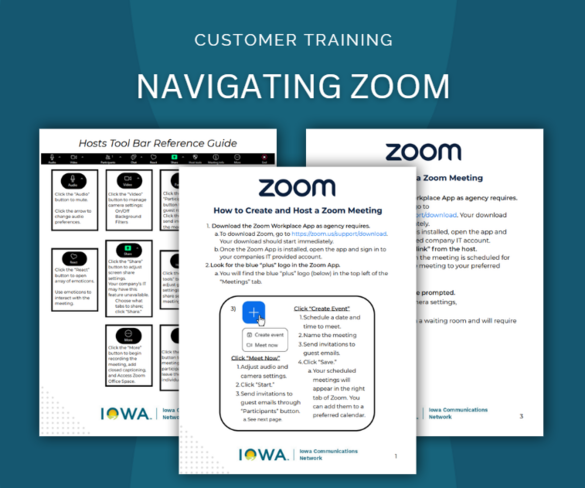
My first task, assigned by the ICN's business services team, focused on creating consumer materials, specifically a "how-to" document for hosting and participating in Zoom meetings. As an authorized Zoom reseller, the ICN's priority is to facilitate easy adoption of the service, which is crucial to maintaining strong customer relations.
To begin, Lori and I reviewed the Zoom Meeting features that needed to be explained to unlock the full potential of Zoom meetings. We took screenshots and drafted instructions based on other online tutorials to make them user-friendly.
Thinking about communications from the customer's point of view became well-mapped for me in this project. Checkups with the communications department provided me with pointers on structure and cohesiveness for a "how-to" based on ease of use.
One of the most important things I learned was from my other supervisor, Courtney. She emphasized clarity in language, that "if you confuse, you lose," and our job as communicators is to respect the recipient's time- an insight that guided many of my design and language choices.
Courtney provided in-depth demonstrations of the graphic design tool Canva for this project, which I will definitely be using again. Through Canva, we coordinated font size, tone, document organization, and effective bullet lists with the customer in mind. As a part of this lesson, Lori demonstrated how she prepares documents for screen reader accessibility. She explained that government entities must meet requirements for accessibility if their work is posted on a public-facing website. I concluded by presenting the "how-to" document to an ICN project manager, who distributed the training to a new customer. Finding a groove in my introductory project was an enriching process.
Combining Communication Visions
I understood that the government was in a fundamental position to provide thorough communication and this was bolstered from a meeting I had with the Iowa Department of Natural Resources (DNR) Communications Team.
Through the ICN, I was able to meet with the Iowa DNR’s communications team to compare strategies and organizational structures with the ICN. From this meeting I gained insight that government agencies must operate within legislative mandates rather than public perception alone and that their online presence is designed to build trust through openness and accessibility, much like the ICN.
Across these interactions with communications professionals and industry experts, a consistent theme emerged: trust is foundational for effective public service. State governments are not meant to operate behind the scenes, but to actively reduce public suspicion through transparency and accessibility which is the true task of a communications staff. While I applaud the ICN for their "trueness to this reality," it was now time for me to compare similar networks compositions and missions across the USA, which required a deep dive into the infrastructure.
Deep Dive in Broadband Network Analysis
To begin analyzing and comparing broadband networks of significant scale, I started researching networks for public service that received state funding, and/or were owned by governing bodies. Private-sector networks were included only if they were essential to government connectivity.
With these parameters in mind, I was able to track a wide range of networks, including open-access networks, consortium-based models, research and education networks (RENs), government-owned networks, and other significant interconnection points, such as gigapops and regional networks. These findings prompted many new questions, and I was fortunate to be surrounded by ICN specialists with backgrounds in engineering, sales, and communications, who helped contextualize and refine my understanding.
Throughout my conversations around the office, I gained the insight into routing mechanics, traffic capacity, wavelength-based transport systems, and switching infrastructure. I learned broadband vocabulary and of funding within the State of Iowa. I even learned about competition and collaboration among telecom providers through an allegory of railroads: that to travel on the railroad, one must stop at a grand station to reach their destination. No single company built the railroad alone.
All of this newfound understanding fed back into my research, and I found myself in a constant state of revision and addition. As my knowledge of the fiber industry expanded, so did my understanding of the internet as both a commodity and a utility. At the end of my project, I had compiled comprehensive overviews of broadband networks nationwide.
Ready for the Next Phase
As this time comes to a close, what stands out is not any single project, but the conversations that helped tune my understanding of state government, public service, and my career. When walking into the ICN in the fall, I was unsure of how this experience would turn out. Walking out, I have a clearer sense of how government, communication, and technology work together to serve the public.
I gained a deeper appreciation for these responsibilities and the comprehensive approach that ICN has adopted for their internal and external communications. Through my internship, I now have a better strategy for incorporating thoughtfulness into communication as I continue to work towards a career in public relations.